

• Contact
  • About
  • ISSN 3049-9712
  • Authors and editors
NEWSLETTER SIGN UP
Bylines Cymru
Advertisement
  • Home
  • Politics & Society
    • Devolution
    • Economy
    • Education
    • Europe
    • Health
    • Housing
    • Media
    • Trade
    • Westminster
  • Arts & Culture
  • Hiraeth
  • Voices
    • Deialog | Interview
    • Editorial
    • Gwalia | History
    • Opinion
    • Poetry
  • Sports
No Result
View All Result
Bylines Cymru
Home Arts & Culture

Hen Galan: one Welsh community welcomes the new year on 14 January

If you don’t feel you started the new year right, you’ll have a chance to begin anew if you pop to Pembrokeshire this weekend for Hen Galan

Eryn White by Eryn White
12-01-2024 18:09
in Arts & Culture
Reading Time: 6 mins read
A A
The children of Cwm Gwaun go door to door singing and collecting calennig in 1961

The children of Cwm Gwaun go door to door singing and collecting calennig in 1961. Geoff Charles/National Library of Wales

Share on Bluesky

A small community in Pembrokeshire will be holding its annual new year celebrations on 14 January, or Hen Galan as it is known in Welsh. But the residents of Cwm Gwaun near Fishguard are not a fortnight late.

Rather, the people of this small wooded hamlet still observe the dates of an old calendar, which was dispensed with by the rest of Britain more than 250 years ago. The origins of Cwm Gwaun’s new year festivities can be traced back to 1752, the year of calendar reform in Britain. Much of Europe had long since adopted the revised calendar introduced by Pope Gregory XIII in 1582.
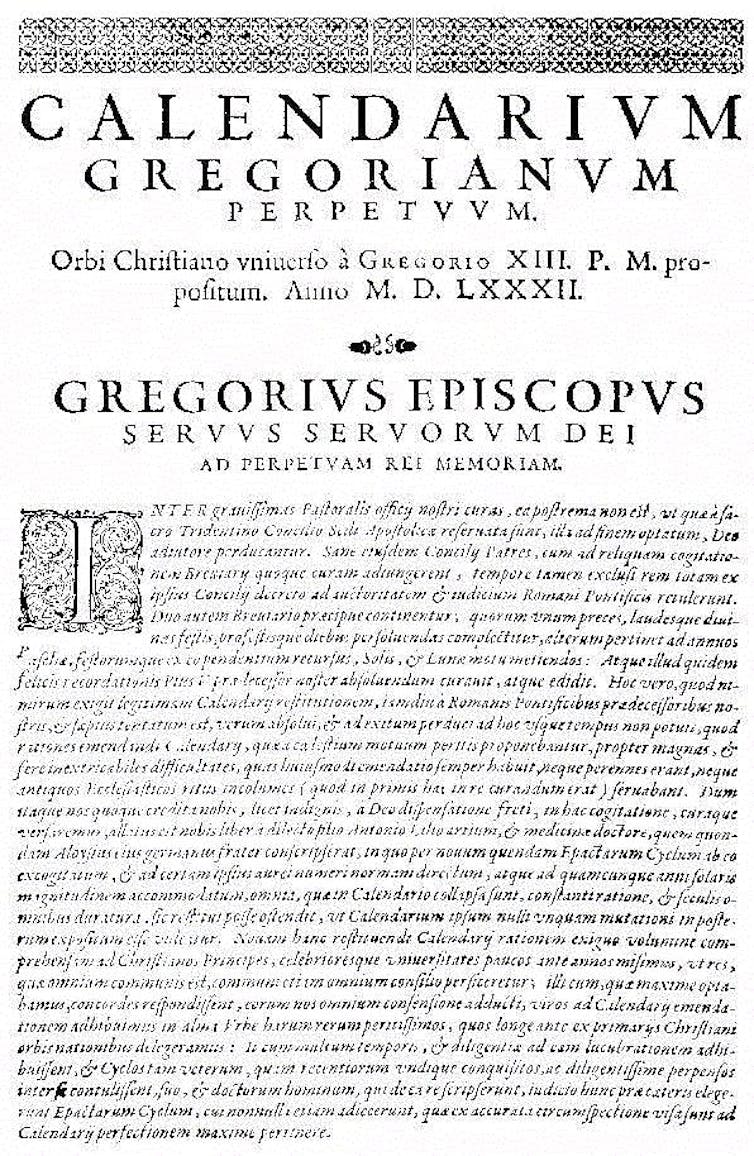
Very old manuscript containing Latin text
The first page of the papal bull ‘Inter Gravissimas’ by which Pope Gregory XIII introduced his calendar.

From Julian to Gregorian

The Gregorian calendar modified the use of leap years in order to keep more accurately to the revolution of the Earth around the Sun. Catholic countries were naturally more inclined to accept this reform. Protestant Britain, however, clung to the traditional way of calculating the year until the middle of the 18th century. That’s when parliament decided enough was enough.

Since the Julian calendar gains a day every 128 years, by the mid-18th century Britain was eleven days ahead of its neighbours on the continent. That created all sorts of complications for trade and diplomacy. It’s just as well there were no Eurovision or World Cup events to organise at the time.

The Calendar Act ensured Britain would come into line with its neighbours in western Europe by simply abolishing 11 days. As a result, in 1752, 2 September was immediately followed by 14 September. This caused controversy, as well as confusion and unease for those with birthdays falling during that period.

The Act also had a significant impact on the celebration of the new year, which from 1752 onwards was to start on 1 January, rather than 25 March as had been the custom. For some time afterwards, dates between 1 January and 24 March appeared as ‘1752/3’ or ‘1752 Old Style/1753 New Style’, as confusion continued between those who embraced the new practice and those who preferred to carry on as before.
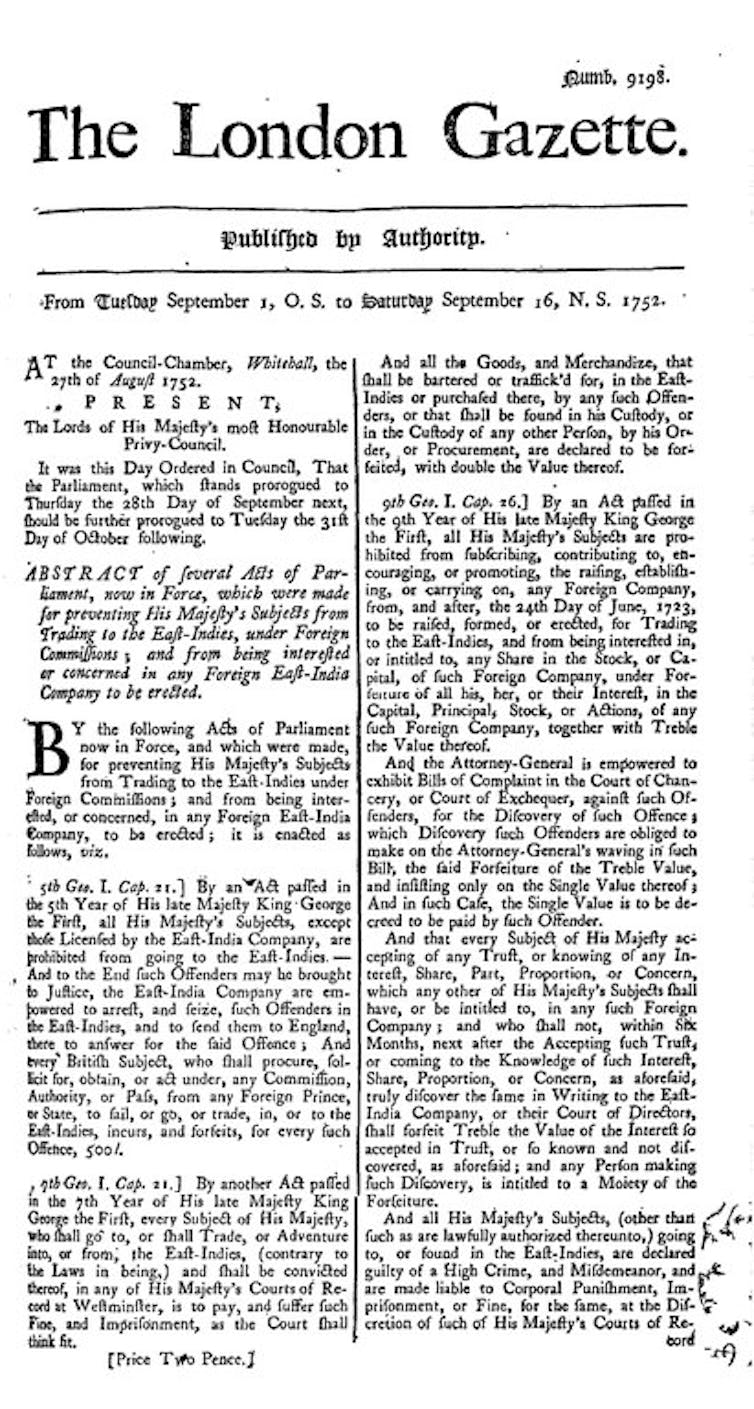
The front page of The London Gazette in September 1752
Issue 9198 of The London Gazette, covering the calendar change in Britain. The issue spans the change, with the date reading: ‘From Tuesday September 1, O.S. (old style) to Saturday September 16, N.S. (new style) 1752’. The Gazette

Ongoing side-effects

One side-effect is the tax year beginning on 6 April, which is the old date for the new year of 25 March, with the missing 11 days added on. It is not hard to see why some people would have shaken their heads at such upheaval and carried on marking the days as they had always done. The legislation mainly applied to the civil calendar rather than the religious one.

Although Catholic and Protestant churches largely came to accept the Gregorian calendar, the Orthodox church kept to the Julian calendar and celebrates Christmas later than other Christian churches. Of course, the difference between the followers of the two different calendars grows gradually, and more than 11 days now separate them.

Cwm Gwaun is one place that has tackled such uncertainty head on. The first day of January was already commonly celebrated as New Year’s Day or Dydd Calan in much of Wales before these official changes. But in Cwm Gwaun, the 11 lost days of 1752 were maintained, so their new year fell in line with the Orthodox new year.

Thus, the tradition of Hen Galan, or old New Year’s Day, was born and is adhered to in this Welsh-speaking area. The customs associated are very much in line with 1 January celebrations in Wales, so it is mainly the timing that is unique.

Hen Galan in Cwm Gwaun

Among the old traditions that continue in Cwm Gwaun is the collecting of calennig, or a new year’s gift, usually by children. Groups circulate from house to house, knocking on doors and offering new year’s greetings, usually in song and verse. Each home would be sure of good luck for the coming year if they responded with gifts, originally of food to help sustain families through the difficult months of winter, but in more recent years of money or sweets.

Anyone who did not welcome and reward visitors would receive a year of bad luck (llond y tŷ o fwg, which means ‘a house full of smoke’), according to one verse. Calennig collectors knocking on doors after midday on Dydd Calan, however, could safely be refused as they were out of time.

And time is, of course, the crucial element in all of this. Agreeing on how we decide to calculate and mark its passing has been a complicated element in human history. Hen Galan in Cwm Gwaun is a yearly reminder of that.

Eryn White, Reader, Aberystwyth University. This article is republished from The Conversation under a Creative Commons license. Read the original article.

Tags: Welsh cultureWelsh history
Previous Post

Welsh Government must act on airborne infections in healthcare settings

Next Post

Local democracy reporting: news from and for Wales

Eryn White

Eryn White

Dr Eryn White is a Reader in the Department of History and Welsh History at Aberystwyth University. She is a historian of early modern Wales, with special interests in religion, culture, and society. She has published extensively on 18th century Wales in particular, but has also worked on print culture in Wales more broadly, and on early Welsh Nonconformity. Other interests include the history of crime and of landownership, especially in South West Wales, and she is the editor of Ceredigion, the journal of the Ceredigion Historical Society. She is a member of a number of editorial boards, including for Studies in Welsh History for the University of Wales Press.

Related Posts

A drawing of old houses.
Arts & Culture

A match made in Wales: Lowry’s overlooked Welsh works

by Dr Huw Evans
14 October 2026
Woman in black long sleeve shirt sitting on floor looking at paintings on a wall.
Arts & Culture

Political inaction keeps the myth of ‘No Welsh Art’ alive

by Dr Huw Evans
7 October 2026
Books stacked on an old wagon situated on the side of a road.
Arts & Culture

The write stuff: why every author needs to read

by John Greeves
27 September 2026
Facade of a Gothic cathedral with tall spires and sculpted reliefs; a busy plaza with tourists in front.
Arts & Culture

Bath, Wales and a patchwork of unlikely connections

by John Greeves
18 August 2026
A man standing on a stage with 3 other men holding a ceremonial sword over his head.
Arts & Culture

The National Eisteddfod – a microcosm of Welsh Life

by Anna Roberts
11 August 2026 - Updated on 17 August 2026
Next Post
Local democracy - Menai Bridge

Local democracy reporting: news from and for Wales

PLEASE SUPPORT OUR CROWDFUNDER

BROWSE BY TAGS

austerity Austerity Project Brexit campaign climate change community Cost of living Covid Cymraeg democracy devolution economy education energy environment equality events general election health history identity inclusion independence international journalism mental health older people opinion party politics Plaid Cymru Poetry Sunday politics public health public services research Senedd South Wales Welsh culture Welsh Government Welsh heritage Welsh history Welsh language Welsh poetry Welsh writers Westminster
Bylines Cymru

We are a not-for-profit citizen journalism publication. Our aim is to publish well-written, fact-based articles and opinion pieces on subjects that are of interest to people in Cymru and beyond.

Bylines Cymru is a trading brand of Bylines Networks Limited which is separate to, but allied with, Byline Times.

Learn more about us

No Result
View All Result
  • About
  • Authors and editors
  • Complaints
  • Contact
  • Donate
  • Privacy
  • Network Map
  • Network RSS Feeds
  • Submission Guidelines
  • Download the Bylines Network App

© 2023-2026 Bylines Cymru. Powerful Citizen Journalism. ISSN 3049-9712

No Result
View All Result
  • Politics & Society
    • Devolution
    • Economy
    • Education
    • Health
    • Housing
    • Media
    • Trade
    • Westminster
  • Arts & Culture
  • Hiraeth
  • Voices | Lleisiau
    • Deialog | Interview
    • Editorial
    • Gwalia | History
    • Opinion
    • Poetry
  • Sports & Leisure

Newsletter sign up

CROWDFUNDER

© 2023-2026 Bylines Cymru. Powerful Citizen Journalism. ISSN 3049-9712

