



We’re all familiar with the iconic Welsh red dragon flag, Y Ddraig Goch, which has been voted ‘the coolest flag in the world’. But it’s only been the official national flag since 1959, in the same decade that Cardiff was established as the capital city of Wales (1955). That’s the flag that people most associate with Wales now. But there are other historic flags that are part of the heritage of Wales, and which are also still in use.
The problem with researching history is that, the farther back you go, the fewer original documents there are. A statement by one source is often repeated by another source without adequate fact-checking, and then: “What I tell you three times is true …”. What I outline here is true to the best of my knowledge, and cautionary terms are used when appropriate.
Owain Glyndŵr’s flag

The flag of Owain Glyndŵr, who is often considered to be the last true – that is, Welsh – Prince of Wales, is not an ‘official’ national flag. I’ve included it because it has gained popularity in recent years. With the rise of Welsh nationalism, it’s often used as a symbol of protest.
The origin of this flag is a matter of debate, but it bears a close resemblance to the flag of Llewelyn ap Gruffudd, who also held the title of Prince of Wales. On Glyndŵr’s flag above, the lions are ‘rampant’, while on ap Gruffudd’s flag they are ‘passant guardant’. The modern-day English Princes of Wales use a modified version of ap Gruffudd’s flag.
St David’s flag

In addition to Y Ddraig Goch, the flag of St David – or its colours – is sometimes used to represent Welsh nationality. It’s flown especially on St David’s Day, but also at other times.
The origins of this flag, bearing a yellow (or gold) cross on a black background, are uncertain. Though it gained prominence in the 20th century, it’s likely to be much older, and some claim it goes back to the seventh century. The arms of the Diocese of St Davids bear a representation of this flag, with the addition of cinquefoils in the cross. It’s not clear which came first, the arms or the flag.
The St David’s flag was adopted as the college colours of the University of Wales at Lampeter in 1888. It was also used as the shoulder badge of the 38th Welsh (Infantry) Division in the second world war. It’s been used by several Welsh football and rugby teams in their club logos, and the colours of black and yellow were adopted by the Welsh rugby team in France in the 2023 World Cup. A reversed version, a yellow flag with a black cross, was at one time used by the Anglican Church in Wales.
The crew of the Pembroke-built Royal Navy cruiser HMS Flora, who were mostly of Pembroke origin, played football in a black-and-yellow kit while docked in Chile in early 1903. They were beaten by the local team from Coquimbo, to whom they gifted some of their jerseys. In 1912, Coquimbo Unido officially adopted the ‘orinegro’ colours, and plays in black-and-yellow in the Chilean First Division to this day.
History of the red dragon
The red dragon is closely associated with Wales and the Welsh people, and has been for many centuries. Today, the image of the red dragon is used ubiquitously throughout Wales. Many companies – though this isn’t restricted to Wales – have the word ‘dragon’ in their name, often with a red dragon-themed logo.
The origin of the Welsh dragon goes back at least to Roman times. The draco (Latin for ‘dragon’ or ‘serpent’ – the terms were interchangeable) was a military standard of the Roman cavalry. It was the standard of a cohort, just as the eagle was the standard of a legion. It may have been introduced after the defeat of the Dacians in the second Century, as the dragon had been a Dacian military standard.
According to the Roman writer Vegetius, it was used universally in the Roman army by the fourth century. So this standard would have been used by Roman soldiers in late-Roman Britain. It may well have been picked up on by the Britons because the dragon was seen as a symbol of power and leadership in Celtic mythology. (And others; the myth of the dragon is found in many cultures worldwide). There’s a story, probably apocryphal, of Romano-British troops carrying a red dragon on their banners to Rome.
It’s believed that the kings of Aberffraw adopted the dragon in the early fifth century, to symbolise their power after the Romans withdrew from Britain. In the seventh century it became known as ‘the Red Dragon of Cadwaladr’, for the king of Gwynedd from 655CE to 682CE.
Head dragons
The use of the red dragon to represent the Welsh can be found in the Historia Brittonum, written around 828CE. It includes the story of a king named Vortigern, who wanted to build a large fortress in Beddgelert to defend himself from the Saxons. While digging the foundations, he uncovered two dragons locked in battle. One of these dragons was white, representing the invading Saxons. The other was red and signified Vortigern and his people. After a fierce conflict, the red dragon was victorious.
The imaginative historian Geoffrey of Monmouth also tells this story, considerably embellished, in his Historia Regum Britanniae. It was written between 1120 and 1129, linking it with the Arthurian legends. He mentions Uther Pendragon as the father of King Arthur. Geoffrey translates Pendragon literally as ‘Dragon Head’, but it’s usually translated as ‘Head Dragon’. That was a title often used by a chieftain or war leader, the Welsh term ‘draig’ (dragon) being used to mean a warrior.
The battle of dragons is also mentioned in the Mabinogion, a collection of medieval Welsh stories dating from around the 11th and 12th centuries, in the story of Lludd and Llefelys.
Development of current red dragon flag

Before it became so closely associated with Wales, the dragon in various forms and colours was used as a symbol of power and strength by many rulers, including early English kings.
Owain Glyndŵr didn’t have a dragon on his regular flag, but did raise the Golden Dragon flag as his battle standard on Twt Hill at the siege of Caernarfon Castle in 1401. The colour choice may have been because Geoffrey of Monmouth claimed King Arthur bore a golden dragon standard into battle. Glyndŵr’s golden dragon is more correctly described as a wyvern, a two-legged dragon. He also had a wyvern-type dragon on his privy seal as Prince of Wales.
The Welsh archers at the Battle of Crecy in 1346 wore a uniform of green and white by order of Edward III. These may have been based on the colours of the leek, and would become the background of the red dragon flag.
The English king Henry Tudor, Henry VII (1485–1509) was of Welsh descent. On one of his royal standards he used an image of the four-legged red dragon on a background of green and white – the Tudor livery colours – which was continued by his son Henry VIII. The shape of the dragon and the background colours clearly foreshadow the modern-day Welsh flag. (A royal standard isn’t the same as a national flag; it’s used only by the sovereign).

He also had a red dragon on his coat of arms, as did Henry VIII. During Henry VIII’s reign a red dragon on a green-and-white background became a common emblem on Royal Navy ships. Contradictory as it may seem, the English under Henry VIII actually bore the red dragon standard into battle against the Welsh.
The red dragon leads the way
With the change of dynasties, the red dragon emblem fell out of use among the English royalty. In 1800, George III issued a royal warrant granting Wales an official royal heraldic badge, blazoned as: “On a mount vert a dragon passant with wings elevated gules (red)”.
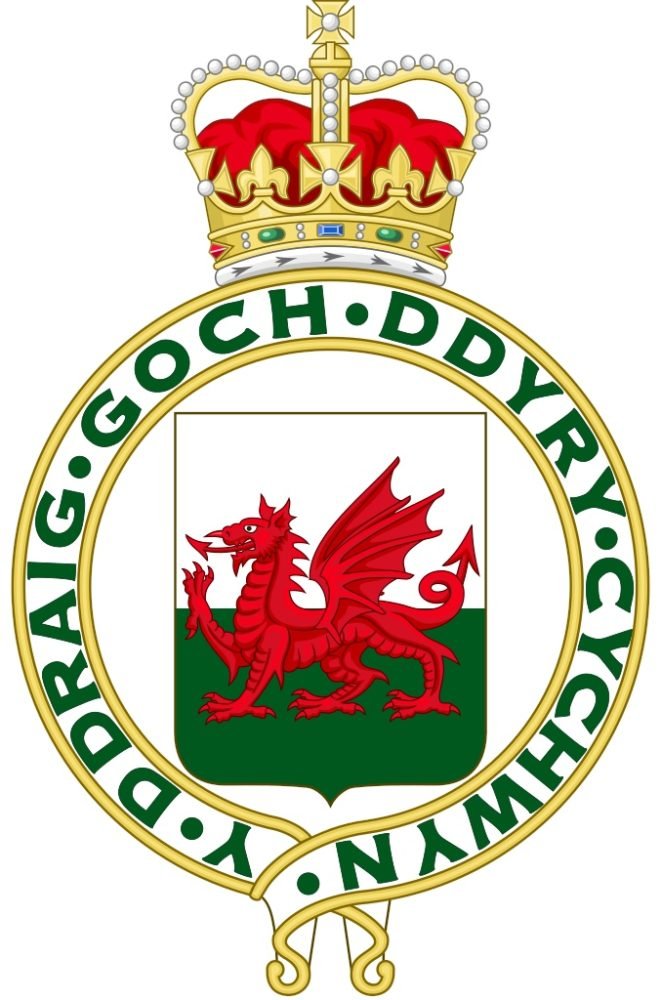
For the coronation of Elizabeth II in 1953, that badge was augmented with the words ‘Y DDRAIG GOCH DDYRY CYCHWYN’, from a 15th century poem by Deio ap Ieuan Du. They’re usually translated as: ‘The red dragon leads the way’. It was flown from civic buildings, on a green-and-white background.
Until 1959 it was claimed that Wales didn’t actually have a flag, only a royal badge. At the urging of the Gorsedd of Bards, and with the approval of Queen Elizabeth II, the centre of the badge was made into the official national flag of Wales, with the heraldic description ‘a red dragon passant on a green and white field’. Today it is recognised all over the world as well as being much-beloved at home in Wales.