

• Contact
  • About
  • ISSN 3049-9712
  • Authors and editors
NEWSLETTER SIGN UP
Bylines Cymru
Advertisement
  • Home
  • Politics & Society
    • Devolution
    • Economy
    • Education
    • Europe
    • Health
    • Housing
    • Media
    • Trade
    • Westminster
  • Arts & Culture
  • Hiraeth
  • Voices
    • Deialog | Interview
    • Editorial
    • Gwalia | History
    • Opinion
    • Poetry
  • Sports
No Result
View All Result
Bylines Cymru
Home Arts & Culture

Weird Medieval Guys: a romp through the Middle Ages

If you think modern cartoon characters are weird, wait until you see these Weird Medieval Guys. This entertaining book is also educational

Madeleine S. Killacky by Madeleine S. Killacky
13-02-2024 11:44
in Arts & Culture
Reading Time: 5 mins read
A A
Weird medieval guys in battle. Including rabbits

From a medieval manuscript, British Library. Image in public domain

Share on Bluesky

Packed full of satire, stunning imagery, and interactive maps and quizzes, Weird Medieval Guys is a deep dive into some of the most extraordinary – and quirky – aspects of medieval daily life. This little book, which should appeal to older children as well as adults, is split into two parts, The Struggle: Surviving Life, Love, and Death, and The Bestiary.

Weird Medieval Guys is a riot, packed full of brilliant medieval facts. Its author, Olivia Swarthout, has been creative in using quizzes and puzzles to engage readers who might like history but don’t get on with dense scholarly texts in the wonderful, wacky world that is the Middle Ages. What is particularly evident to me, as an expert in medieval literature, is the number of hours she has spent consulting digitised manuscripts from the first century onwards, as well as old and recent scholarship on medieval manuscript culture and life in general.

Surviving life

Beginning at the beginning (the Bible’s seven days of creation), the reader is taken on a riveting ride through a series of manuscript images – small, square, Instagram-like windows bursting with life and colour – that depict both the normalcy and turbulence of everyday life in medieval times. As you make your way through the book you can pick a patron saint, a name, and a job, and even learn a little Middle English slang.

Now fully equipped for the journey of a lifetime, Swarthout moves swiftly to tell you everything you need to know about surviving the ups and downs of finding an ideal partner. Such as: should you carry your dagger at all times? Does one need a pudding-basin haircut? What was that secret aphrodisiac ingredient for that love potion you want to concoct?

Swarthout answers all of this and more as she delves into some of the funniest and weirdest traditions of the Middle Ages. The book is not too far off the mark, but does forgo some of the finer details about women’s lived experiences of marriage throughout the Middle Ages. What we know from medieval manuscript sources tells a slightly different story, in which marriage was less about love and more about political arrangements.

Danse Macabre

Part one finishes by discussing death. Although never a particularly appealing topic, it wasn’t all doom and gloom in medieval times. Rather, Swarthout includes images from medieval manuscripts of the ‘Danse Macabre’ (dance of death), which depicts a skeletal personification of death leading people of all ages and walks of life in a dance to their graves, occasionally with musical accompaniment.

As a medieval scholar, I found this approach to exploring life and death in the Middle Ages engaging. But Swarthout does well to make the sometimes difficult and grisly subjects approachable to non-expert readers through the book’s use of full-colour images, puzzles, and flowcharts.

Weird medieval animals

Part two, The Bestiary, is rather different and catalogues the animal side of life in the Middle Ages. Moving systematically through the four categories of the animal kingdom – beasts, birds, fish, and serpents – Swarthout does a very good job of giving the reader a fully-fledged tour of everything you could ever want to know about these animals.

Again, there is fun to be had and facts a plenty you’ll want to share with friends. Take, for instance, the fact that in medieval folklore, hedgehogs were said to use their quills to carry great amounts of food on their backs. Or that eels were valuable creatures used by many as a form of payment.
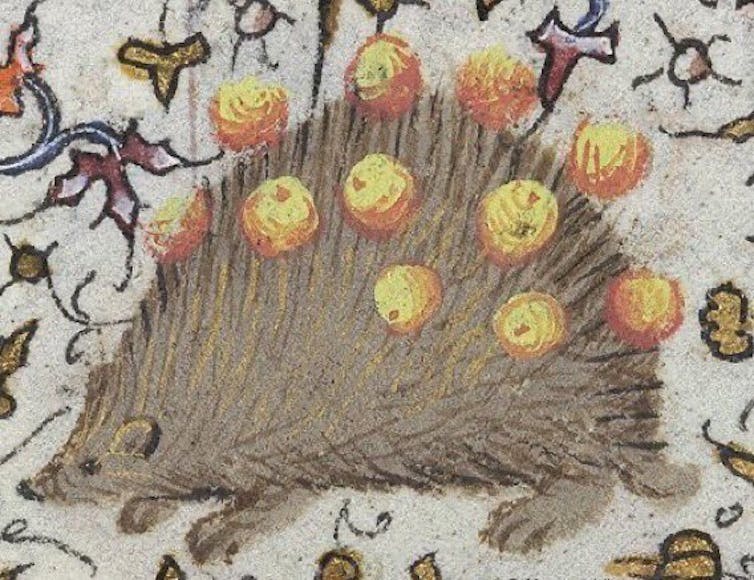
A medieval drawing of a hedgehog carrying food.
A medieval drawing of a hedgehog carrying food. British Library, CC BY-NC

Again, Swarthout has done her research, drawing on medieval manuscripts called bestiaries, which still survive today. These were treatises on various real or mythical kinds of animals, often accompanied by moralising anecdotes.

Weird Medieval Guys is an entertaining book. It’s bright and colourful and would make a perfect gift for anyone with an interest in the Middle Ages, or in history more generally. Although this is by no means a scholarly text, the purpose of the book – to give a fun introduction to life in the Middle Ages – is more than well achieved. Most of all, the text is enticingly re-readable and will remain a favourite for the non-expert, while also being enjoyable to the specialist.


Madeleine S. Killacky, PhD Candidate, Medieval Literature, Bangor University. This article is republished from The Conversation under a Creative Commons license. Read the original article.
CLICK HERE TO SUPPORT THE BYLINES NETWORK CROWDFUNDER!

Tags: book reviewmedieval
Previous Post

Putting the broke in Pembrokeshire: a council in dire straits

Next Post

Why is the Welsh Government at war with arts, culture, and heritage?

Madeleine S. Killacky

Madeleine S. Killacky

Madeleine S. Killacky is a PhD candidate in Medieval Literature at Bangor University. She specialises in 15th century material culture and the history of the book, and is also researching the intersection of literature and STEM. She holds degrees in English Literature and Biology. She is a member of the Royal Historical Society and Royal Society of Biology, and writes public scholarship for History Today and Conservation Physiology.

Related Posts

A drawing of old houses.
Arts & Culture

A match made in Wales: Lowry’s overlooked Welsh works

by Dr Huw Evans
14 October 2026
Woman in black long sleeve shirt sitting on floor looking at paintings on a wall.
Arts & Culture

Political inaction keeps the myth of ‘No Welsh Art’ alive

by Dr Huw Evans
7 October 2026
Books stacked on an old wagon situated on the side of a road.
Arts & Culture

The write stuff: why every author needs to read

by John Greeves
27 September 2026
Facade of a Gothic cathedral with tall spires and sculpted reliefs; a busy plaza with tourists in front.
Arts & Culture

Bath, Wales and a patchwork of unlikely connections

by John Greeves
18 August 2026
A man standing on a stage with 3 other men holding a ceremonial sword over his head.
Arts & Culture

The National Eisteddfod – a microcosm of Welsh Life

by Anna Roberts
11 August 2026 - Updated on 17 August 2026
Next Post
Arts, culture, and heritage: woman sitting in a gallery with empty frames

Why is the Welsh Government at war with arts, culture, and heritage?

PLEASE SUPPORT OUR CROWDFUNDER

BROWSE BY TAGS

austerity Austerity Project Brexit campaign climate change community Cost of living Covid Cymraeg democracy devolution economy education energy environment equality events general election health history identity inclusion independence international journalism mental health older people opinion party politics Plaid Cymru Poetry Sunday politics public health public services research Senedd South Wales Welsh culture Welsh Government Welsh heritage Welsh history Welsh language Welsh poetry Welsh writers Westminster
Bylines Cymru

We are a not-for-profit citizen journalism publication. Our aim is to publish well-written, fact-based articles and opinion pieces on subjects that are of interest to people in Cymru and beyond.

Bylines Cymru is a trading brand of Bylines Networks Limited which is separate to, but allied with, Byline Times.

Learn more about us

No Result
View All Result
  • About
  • Authors and editors
  • Complaints
  • Contact
  • Donate
  • Privacy
  • Network Map
  • Network RSS Feeds
  • Submission Guidelines
  • Download the Bylines Network App

© 2023-2026 Bylines Cymru. Powerful Citizen Journalism. ISSN 3049-9712

No Result
View All Result
  • Politics & Society
    • Devolution
    • Economy
    • Education
    • Health
    • Housing
    • Media
    • Trade
    • Westminster
  • Arts & Culture
  • Hiraeth
  • Voices | Lleisiau
    • Deialog | Interview
    • Editorial
    • Gwalia | History
    • Opinion
    • Poetry
  • Sports & Leisure

Newsletter sign up

CROWDFUNDER

© 2023-2026 Bylines Cymru. Powerful Citizen Journalism. ISSN 3049-9712

