

• Contact
  • About
  • ISSN 3049-9712
  • Authors and editors
NEWSLETTER SIGN UP
Bylines Cymru
Advertisement
  • Home
  • Politics & Society
    • Devolution
    • Economy
    • Education
    • Europe
    • Health
    • Housing
    • Media
    • Trade
    • Westminster
  • Arts & Culture
  • Hiraeth
  • Voices
    • Deialog | Interview
    • Editorial
    • Gwalia | History
    • Opinion
    • Poetry
  • Sports
No Result
View All Result
Bylines Cymru
Home Environment

Livestock grazing is preventing the return of rainforests to the UK and Ireland

Activities preventing forests from regeneration should also be seen as deforestation, says Emma Garnett. Livestock grazing is a key obstacle.

Emma Garnett by Emma Garnett
17-03-2023 11:43
in Environment
Reading Time: 9 mins read
A A
Pembrokeshire rainforest

Pembrokeshire rainforest. Photo by Marc Pell on Unsplash

Share on Bluesky

A few years back, the president of the National Farmers’ Union of England and Wales wrote a defence of the meat industry after a BBC documentary criticised its environmental impact. “British farmers do not clear rainforest to make way for beef and lamb production,” she wrote. “British meat does not come from the ashes of the Amazon.”

Many believe this but unfortunately it isn’t quite true. For one thing, livestock production in the UK and Ireland is still linked to rainforests abroad since chickens, pigs, and cows are often fed imported soybeans. Brazil is the world’s largest soybean exporter, and much of its crop is grown on deforested land.

Many people might also be surprised to learn that Ireland and western regions of Great Britain are home to rainforests: temperate forests sometimes called Celtic or Atlantic rainforests. And, like their tropical counterparts, UK and Irish rainforests are threatened by grazing livestock, particularly deer and sheep.

Fragmented forests

Only a tiny and fragmented area of UK and Irish rainforest remains. As the Woodland Trust reports, it “has suffered long-term declines through clearances, chronic overgrazing, and conversion to other uses”.

I’ve found in Twitter discussions that people will argue the treeless state of much of Britain’s National Parks is “natural”, but that’s not the case. When fences are put up and grazing is excluded, trees and vegetation quickly recover.

To protect nature we do need to minimise further deforestation. However, we also need to restore what we have lost. We’re used to viewing present-day tree clearing as deforestation, and we now need to view activities that prevent forests naturally regenerating as deforestation too.

Universal basic income and the environment
Economy

Universal basic income for a just transition

by Jonathan Williams
1 March 2023

Livestock grazing has huge land footprints

Most of the UK and Ireland’s grass-fed cows and sheep are on land that might otherwise be temperate rainforest – arable crops tend to prefer drier conditions. However, even if there were no livestock grazing in the rainforest zone – and these areas were threatened by other crops instead – livestock would still pose an indirect threat due to their huge land footprint. You need around 35 times more land to get 100g of protein from lamb than you do from peas, beans, and other pulses.

Graph of land use by different forms of protein
Sheep and cows use lots of land. Our World In Data (Data: Poore & Nemecek, Science, 2018), CC BY-SA

Rainforest and livestock grazing are therefore competing for space. The UK and Ireland have some of the lowest forest cover in Europe at 13% and 11% respectively, and only one-tenth of this is natural rather than planted. Eating less meat and more plants means your diet has a smaller land footprint, which means more space for woods and rainforests to return.

Yes, grasslands in the British Isles with low levels of grazing can be important ecosystems for wildflowers and insects, but this is not what most grazing land is like. Grassland nature reserves managed for nature and not farming, such as Martin Down in Hampshire, have trees and shrubs – in the spring and summer the air is filled with birdsong and the ground with butterflies and orchids. They are a far cry from the intensively grazed fields and hillsides which resemble billiard tables and make up too much of the UK and Ireland’s grasslands.

Eating meat off well-managed nature reserves is arguably fine for nature and climate – but such tiny amounts are produced from these systems that meat consumption would have to plummet far beyond current reduction targets.

Furthermore, most British grass-fed cows are still fed crops on top of their staple grass. They typically have a larger arable land footprint per 100g than British legumes, and a massively larger footprint once you factor in their grazing land.

Bar graph
Generally British beef uses more crop land per kilo than British legumes. Emma Garnett (Data sourced from Poore and Nemecek, 2018), Author provided


Nature depletion

There is important on-farm biodiversity which needs to be supported, but this mustn’t be at the expense of conserving and restoring unfarmed ecosystems – which most (but not all) species prefer.
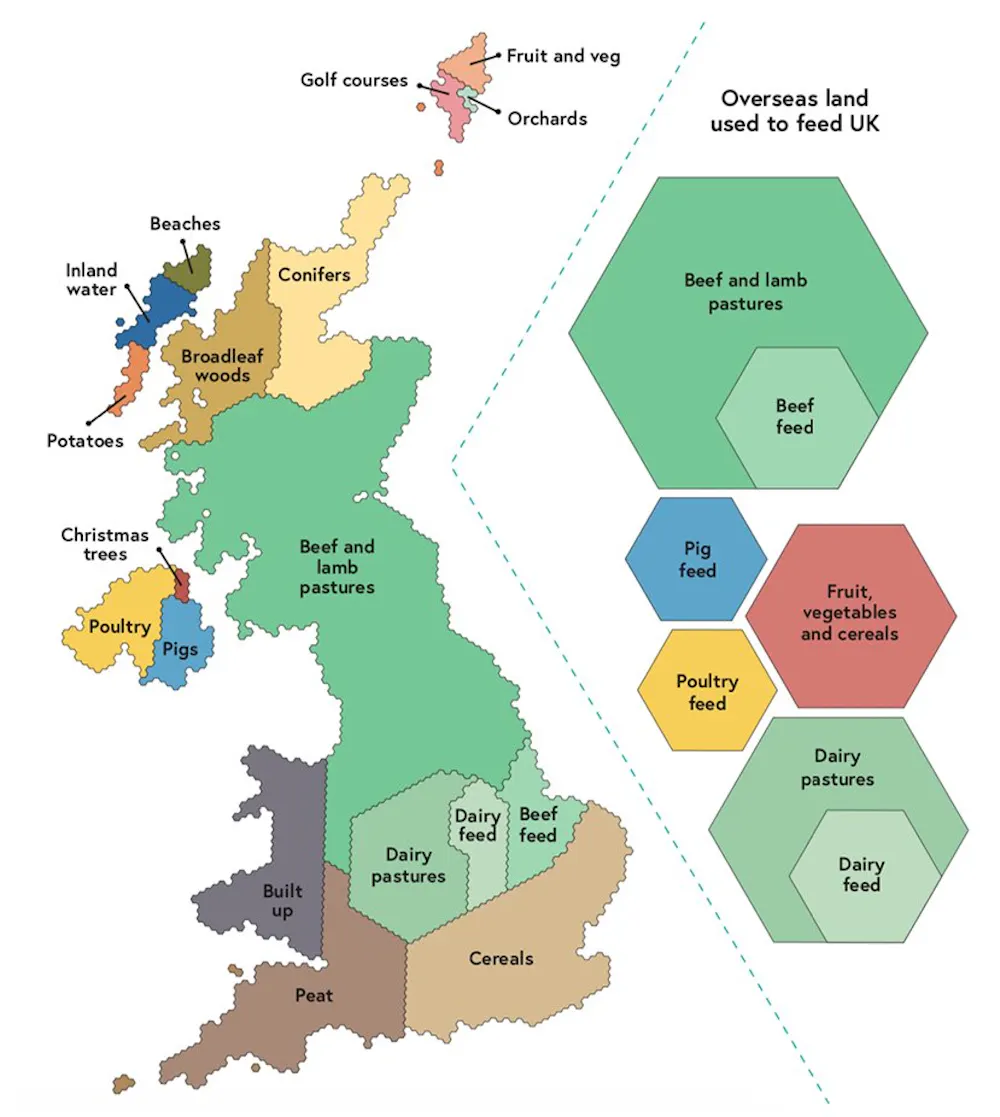
UK land use and overseas land used to feed the UK. Beef and lamb pasture is the main use in both cases. National Food Strategy

The UK and Ireland are some of the most nature-depleted countries in the world. And grazing is the most common land use – the vast majority of grass-fed livestock are harming not benefitting nature.

British and Irish rainforests are moving up the public consciousness thanks to campaigners such as Guy Shrubsole and Eoghan Daltun. People are increasingly aware of the climate impact of meat, but there is still less discussion about its large land footprint and how that harms nature and biodiversity. This will need to change if the world is to achieve recent commitments made at the biodiversity-focused COP15 summit to protect and restore nature.

Emma Garnett, Researcher in the Health Behaviours Team, University of Oxford

This article is republished from The Conversation under a Creative Commons license. Read the original article.

Tags: biodiversityclimate changeforesthabitatlivestock grazingnature depletionrainforest
Previous Post

Remaking an icon: the Red Cross emblem in the digital age

Next Post

What do the Irish and the Welsh make of each other?

Emma Garnett

Emma Garnett

Dr Emma Garnett is a researcher in the Health Behaviours Team at the University of Oxford. She is investigating the efficacy of approaches to reducing meat consumption and moving to more plant-based diets. She’s interested in how we can fairly overcome economic, political, and social barriers to live well within planetary boundaries. She is an Associate Fellow of the Higher Education Academy and won the Janet Moore prize for supervising in Zoology (University of Cambridge).

Related Posts

A crowd of people standing in a town centre and some holding placards.
Community | Cymuned

The battle over the Menai Strait data centre

by Gareth Wyn Roberts
11 October 2026
image by Martha Garcia. Used with permission
Economy

I decluttered my wardrobe and discovered the hidden cost of fast fashion

by Martha Garcia
28 September 2026
Man on the edge of the sea holding a body board with words written on it.
Environment

The tide that washed away our innocence

by Natalie Barnett
24 September 2026
Dirty Sewage is drained into natural public pond.
Environment

A river stripped of life: inside the Kenfig sewage disaster

by Maggie Curley
2 September 2026 - Updated on 7 September 2026
Wildfire burns behind two caravans.
Devolution

Wildfire alerts: right message, wrong delivery

by Dr Huw Evans
25 August 2026
Next Post
Welsh colours in Dingle, Ireland

What do the Irish and the Welsh make of each other?

PLEASE SUPPORT OUR CROWDFUNDER

BROWSE BY TAGS

austerity Austerity Project Brexit campaign climate change community Cost of living Covid Cymraeg democracy devolution economy education energy environment equality events general election health history identity inclusion independence international journalism mental health older people opinion party politics Plaid Cymru Poetry Sunday politics public health public services research Senedd South Wales Welsh culture Welsh Government Welsh heritage Welsh history Welsh language Welsh poetry Welsh writers Westminster
Bylines Cymru

We are a not-for-profit citizen journalism publication. Our aim is to publish well-written, fact-based articles and opinion pieces on subjects that are of interest to people in Cymru and beyond.

Bylines Cymru is a trading brand of Bylines Networks Limited which is separate to, but allied with, Byline Times.

Learn more about us

No Result
View All Result
  • About
  • Authors and editors
  • Complaints
  • Contact
  • Donate
  • Privacy
  • Network Map
  • Network RSS Feeds
  • Submission Guidelines
  • Download the Bylines Network App

© 2023-2026 Bylines Cymru. Powerful Citizen Journalism. ISSN 3049-9712

No Result
View All Result
  • Politics & Society
    • Devolution
    • Economy
    • Education
    • Health
    • Housing
    • Media
    • Trade
    • Westminster
  • Arts & Culture
  • Hiraeth
  • Voices | Lleisiau
    • Deialog | Interview
    • Editorial
    • Gwalia | History
    • Opinion
    • Poetry
  • Sports & Leisure

Newsletter sign up

CROWDFUNDER

© 2023-2026 Bylines Cymru. Powerful Citizen Journalism. ISSN 3049-9712