



The UK Government has argued that a black hole exists in the public finances to the tune of £22bn in this financial year. It claims that dealing with this involves a period of fiscal restraint, which usually means spending cuts. We’ve already been told that the winter fuel allowance for pensioners will be means-tested rather than available for everyone, and cuts to disability benefits and cash ISA limits are threatened. Austerity is once again on the agenda in British politics.
As Keir Starmer’s Labour met for its first annual conference in government last autumn, it had to decide how far it could realistically push this austerity agenda without compromising on its goal to deliver on growth. When testing how much austerity the British public will tolerate, we can look to a recent example in the policies introduced by the Conservative-Liberal Democrat coalition government.
When the coalition formed after the 2010 general election it embarked on major cuts in public spending, which failed to bring down the deficit. It also greatly damaged public services and local government in the process. This in turn helped to produce the slow growth the UK has been experiencing since the great recession of 2008–2010.
Discrediting austerity
One of the surprising things about austerity is that there is little support for it in economic theory. There is an obvious problem for countries like Argentina and Venezuela running huge deficits and trying to borrow in international markets when they have defaulted on loans in the past.
But a country like Britain, which has never defaulted and has a relatively high productive capacity, can borrow extensively on international markets. This is true as long as it avoids shocking them with sudden unfunded tax reductions of the type proposed by Liz Truss during her brief period as prime minister.
A few years ago, American economists Carmen Reinhart and Kenneth Rogoff looked at the relationship between economic growth and borrowing. Their findings appeared to show that borrowing which exceeded 60% of GDP would damage growth in developed countries. This argument gave cover to the coalition government’s austerity policies, since in December 2010, a few months after the election, borrowing exceeded 70% of GDP. George Osborne, chancellor at the time, cited Reinhart and Rogoff as an evidence base to justify his policies.
Embarrassingly for Reinhart and Rogoff, a graduate student at the University of Massachusetts Amherst attempted to replicate their findings. He found that their modelling was full of coding errors, questionable weighting decisions, and other methodological faults that threw doubts on their results. This was widely publicised and largely discredited their findings.
The Relationship between Economic Growth and Debt in the UK, 1993–2023:
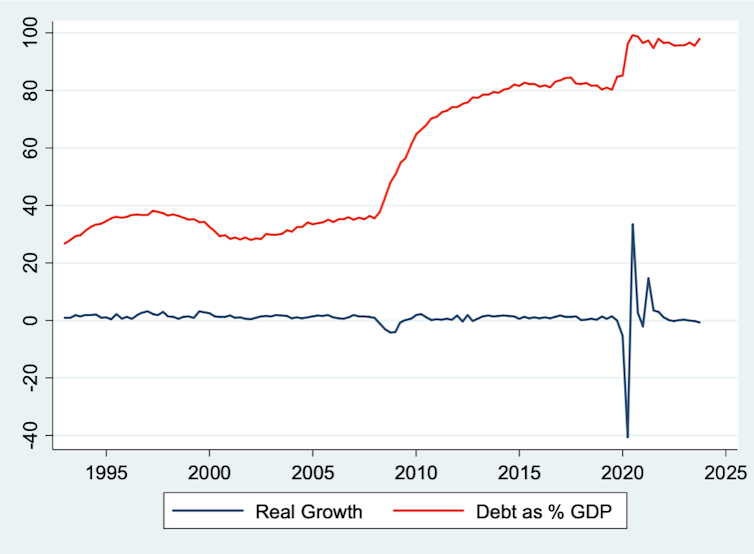
This means it is worth looking again at the relationship between economic growth and borrowing in the UK over a long period of time. The chart above shows that this relationship is negligible (-0.03), indicating that they are unrelated.
Growth and austerity
It is important to take into account other factors which can influence growth when considering Labour’s position. One key factor is consumer confidence, or the extent to which people are feeling positive or negative about the state of the economy and their own financial circumstances.
The chart below looks at the relationship between economic growth, consumer confidence, and public support for successive British governments over a period of nearly half a century (up until 2019, shortly before the pandemic shut down the economy). It suggests that another round of austerity is very likely to reduce growth rather than stimulate it, and this will have serious consequences for the government’s popularity.
Quarterly Government Vote Intentions, Consumer Confidence, and Economic Growth in the UK 1974 (Q1) to 2019 (Q4):

Consumer confidence plays an important role in determining whether consumers will stimulate the economy by spending money. The correlation between this measure and economic growth, taking inflation into account, is strong (0.46), which means that economic optimism and growth go together. Not surprisingly, optimism brings growth and pessimism brings stagnation.
There are also political consequences of austerity policies, since the correlation between voting intentions for the governing party and consumer confidence is also strong (0.47). If the economy is stagnating, people feel pessimistic and they are likely to blame the government for it.
If, on the other hand, they feel optimistic, then the incumbent party gets the credit and increases its lead in the polls. We can see this in the dips in confidence in election years that delivered a change of government.
A virtuous circle
Correlations are not, of course, the same as causation, but further statistical analysis shows that consumer confidence and growth interact with each other. As confidence increases economic growth accelerates, and vice versa.
This can produce a virtuous circle of increased prosperity and government popularity. And while growth does not directly affect government popularity, it works via consumer confidence.
Just days before Labour’s annual conference in 2024, new figures were released showing that consumer confidence had fallen sharply in September. People were recorded as being pessimistic about the national economic outlook and their own finances, possibly as a result of the government’s own messaging about the difficult budget to come.
Starmer and Chancellor Rachel Reeves should take a leaf out of the book of the post-war Labour government. A massive public deficit arising from six years of conflict did not prevent Clement Attlee and his colleagues rebuilding Britain in the post-war years. A continued commitment to austerity could crash the whole Labour project of bringing growth back to a stagnant economy.

Paul Whiteley, Professor, Department of Government, University of Essex. This article is republished from The Conversation under a Creative Commons license. Read the original article.




