

• Contact
  • About
  • ISSN 3049-9712
  • Authors and editors
NEWSLETTER SIGN UP
Bylines Cymru
Advertisement
  • Home
  • Politics & Society
    • Devolution
    • Economy
    • Education
    • Europe
    • Health
    • Housing
    • Media
    • Trade
    • Westminster
  • Arts & Culture
  • Hiraeth
  • Voices
    • Deialog | Interview
    • Editorial
    • Gwalia | History
    • Opinion
    • Poetry
  • Sports
No Result
View All Result
Bylines Cymru
Home Science & Tech

Simply looking at greenery can boost mental health

New research using eye-tracking glasses shows that looking at greenery and other natural elements increases wellbeing even in urban spaces

Whitney Fleming by Whitney Fleming
16-07-2024 11:17
in Science & Tech
Reading Time: 5 mins read
A A
Greenery: a thatched hut with vines growing on it and a lawn with topiary in front at Chirk Castle, North Wales

Photo by JR Harris on Unsplash

Share on Bluesky

It is becoming increasingly clear that spending time in nature can benefit our mental health and wellbeing. But a new study by my colleagues and me shows that you don’t have to actually be in nature to reap the rewards. Simply directing your gaze towards natural elements like greenery, even in the middle of a city, can enhance wellbeing.

Our paper, published in the journal People and Nature, used eye-tracking technology to explore how focusing on natural versus manmade elements affects mental health. Urban living, with its fast pace and high levels of stress, has been linked to numerous mental health issues, including anxiety and depression.

Eye-tracking research

Our research team, which was led by me and consisting of my colleagues Brian Rizowy and Assaf Shwartz, recruited 117 adults for the study. Participants were randomly assigned to one of three groups: one that focused on natural elements such as trees (green group), one that focused on manmade elements such as buildings (grey group), and a third group that focused on a mix of both (mixed group).

Each participant wore specialised eye-tracking glasses during a 45-minute guided walk around town and the campus. The route included ten designated stopping points designed to emphasise either natural or manmade elements, depending on the group.

Before and after the walk, participants completed surveys assessing their mood, anxiety levels, and the restorative quality of the walk. The surveys included standardised measures such as the positive and negative affect schedule (Panas) and the state-trait anxiety inventory (Stai).

The eye-tracking glasses recorded where participants were looking throughout the walk, allowing researchers to quantify the amount of time spent focusing on green (natural) or grey (manmade) elements. In fact, our technique offered a precise and objective measure of visual engagement, strengthening the link between nature exposure and improved wellbeing. The data confirmed that each group really did spend more time looking at the scenery we had asked them to focus on.

Green and grey results

The results were striking. Participants who focused more on green elements reported significant improvements in mood and reductions in anxiety compared to those who focused on grey elements. And they showed higher levels of positive emotions and lower levels of anxiety after the walk. They also reported feeling more refreshed and rejuvenated.
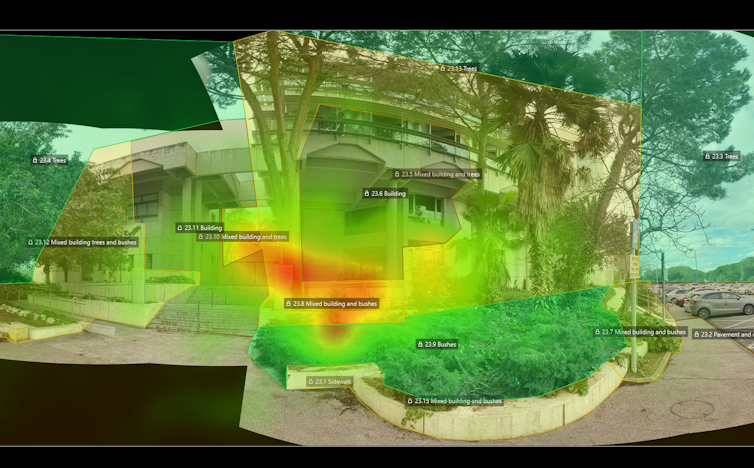
A heatmap depicting areas where participants gazed more or less.
A heatmap depicting areas where participants gazed more or less. Brian Rizowy, CC BY-SA

In contrast, the grey group did not show these improvements, and the mixed group had intermediate results, suggesting that even a partial focus on nature can be beneficial.

These findings have important implications for urban planning and mental health practices. Designing urban spaces that incorporate natural elements and encourage visual engagement with nature like greenery could help reduce the mental health burden of city living. For instance, planners could prioritise green spaces, tree-lined streets, parks, and ponds that invite people to pause and take in the natural beauty.

Greenery for mental health

The findings could also be useful for mental health professionals. For example, they may want to incorporate guided attention exercises into therapy, encouraging patients to specifically focus on natural elements during walks or other outdoor activities. This simple, cost-effective strategy could enhance traditional treatments for anxiety and depression.

The study highlights the importance of visual engagement with nature, providing robust evidence that the mental health benefits of nature are closely tied to where we focus our attention. For the average person, this study suggests an easy way to boost mental health: spend more time looking at trees, flowers, greenery, and other natural elements. Whether during a daily commute, a walk in the park, or a weekend hike, consciously directing your gaze towards nature could make a significant difference in how you feel.

Our research underscores the potential for simple, everyday actions to have a profound impact on mental health. As urban areas continue to grow, integrating natural elements into cityscapes and encouraging people to engage visually with these elements could play a crucial role in enhancing public wellbeing.


Whitney Fleming, Lecturer, School of Environmental & Natural Sciences., Bangor University. This article is republished from The Conversation under a Creative Commons license. Read the original article.


The Conversation
Tags: environmentmental healthpsychologyresearch
Previous Post

A green gas grid for decarbonisation

Next Post

Wales on Wednesday: 118 days

Whitney Fleming

Whitney Fleming

Dr Whitney Fleming is a lecturer in the School of Environmental and Natural Sciences at Bangor University. She’s an experienced researcher skilled in data analysis, public speaking, environmental awareness, GIS, R studio, and collaborative teamwork. She has a PhD in Environmental Science and governance, and a Masters focused on Public Affairs and Environmental Policy from the University of Washington. She’s led research projects in environmental psychology, focusing on the relationship between human behaviour and the built and natural environment, and has designed and conducted experimental studies to investigate the relationship between individuals and their physical and social environments.

Related Posts

White-tailed eagle in flight.
Environment

Could the eagle be landing in Wales?

by Dr Huw Evans
8 November 2026
A U-shaped valley.
Community | Cymuned

Nant Ffrancon: a rewilding revolution or the evolution of a landscape

by John Ratcliffe
30 October 2026
A planet in space
Environment

When earth’s orbit shaped the South Wales Coalfield

by Paul Bright
29 October 2026
Bushfires in tropical forest release carbon dioxide (CO2) emissions and other greenhouse gases (GHG) that contribute to climate change.
Environment

Record greenhouse gases demand action at COP 31

by Brian McHugh
29 October 2026
Code editor displaying react source code.
Devolution

When democracy can’t keep up: is Wales ready for government by algorithm?

by Martha Garcia
16 October 2026
Next Post
08/07/2024, Cardiff. Prime Minister Keir Starmer meets the First Minister of Wales, Vaughan Gething, on his Union tour

Wales on Wednesday: 118 days

PLEASE SUPPORT OUR CROWDFUNDER

BROWSE BY TAGS

austerity Austerity Project Brexit campaign climate change community Cost of living Covid Cymraeg democracy devolution economy education energy environment equality events general election health history identity inclusion independence international journalism mental health older people opinion party politics Plaid Cymru Poetry Sunday politics public health public services research Senedd South Wales Welsh culture Welsh Government Welsh heritage Welsh history Welsh language Welsh poetry Welsh writers Westminster
Bylines Cymru

We are a not-for-profit citizen journalism publication. Our aim is to publish well-written, fact-based articles and opinion pieces on subjects that are of interest to people in Cymru and beyond.

Bylines Cymru is a trading brand of Bylines Networks Limited which is separate to, but allied with, Byline Times.

Learn more about us

No Result
View All Result
  • About
  • Authors and editors
  • Complaints
  • Contact
  • Donate
  • Privacy
  • Network Map
  • Network RSS Feeds
  • Submission Guidelines
  • Download the Bylines Network App

© 2023-2026 Bylines Cymru. Powerful Citizen Journalism. ISSN 3049-9712

No Result
View All Result
  • Politics & Society
    • Devolution
    • Economy
    • Education
    • Health
    • Housing
    • Media
    • Trade
    • Westminster
  • Arts & Culture
  • Hiraeth
  • Voices | Lleisiau
    • Deialog | Interview
    • Editorial
    • Gwalia | History
    • Opinion
    • Poetry
  • Sports & Leisure

Newsletter sign up

CROWDFUNDER

© 2023-2026 Bylines Cymru. Powerful Citizen Journalism. ISSN 3049-9712

