

• Contact
  • About
  • ISSN 3049-9712
  • Authors and editors
NEWSLETTER SIGN UP
Bylines Cymru
Advertisement
  • Home
  • Politics & Society
    • Devolution
    • Economy
    • Education
    • Europe
    • Health
    • Housing
    • Media
    • Trade
    • Westminster
  • Arts & Culture
  • Hiraeth
  • Voices
    • Deialog | Interview
    • Editorial
    • Gwalia | History
    • Opinion
    • Poetry
  • Sports
No Result
View All Result
Bylines Cymru
Home Science & Tech

What you should know about that padlock icon on your browser

Very few people know what the padlock represents, which can increase potential online risks and affect user experience

Fiona Carroll by Fiona Carroll
26-02-2024 15:49
in Science & Tech
Reading Time: 6 mins read
A A
An open padlock sitting on a keyboard in red and green tones

Photo by FlyD on Unsplash

Share on Bluesky

Do you know what the padlock symbol in your internet browser’s address bar means? If not, you’re not alone. New research by my colleagues and I shows that only 5% of UK adults understand the padlock’s significance. This is a threat to our online safety.

The padlock symbol on a web browser simply means that the data being sent between the web server and the user’s computer is encrypted and cannot be read by others. But when we asked people what they thought it meant, we received an array of incorrect answers.

Understanding the padlock

In our study, we asked a cross section of 528 web users, aged between 18 and 86 years of age, a number of questions about the internet. Some 53% of them held a bachelor’s degree or above and 22% had a college certificate, while the remainder had no further education.

One of our questions was: “On the Google Chrome browser bar, do you know what the padlock icon represents/means?” Of the 463 who responded, 63% stated they knew, or thought they knew, what the padlock symbol on their web browser meant, but only 7% gave the correct meaning.

Respondents gave us a range of incorrect interpretations, believing among other things that the padlock signified a secure web page or that the website is safe and doesn’t contain any viruses or suspicious links. Others believed the symbol means a website is “trustworthy”, is not harmful, or is a “genuine” website.
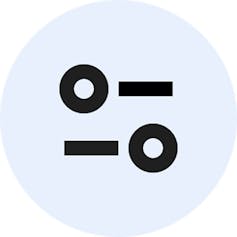
A symbol of a circle next to a straight line over a straight line and a circle.
Google’s new ‘tune icon’ which replaces the padlock icon in Chrome’s address bar. Google Chromium, CC BY

Not understanding symbols like the padlock icon can pose problems for internet users. These include increased security risks and simply hindering effective use of the technology.

Our findings corroborate research by Google itself, which in September replaced the padlock icon with a neutral symbol described as a ‘tune icon’. In doing so, Google hopes to eradicate the misunderstandings that the padlock icon has afforded. However, Google’s update now raises the question as to whether other web browser companies will join forces to ensure their designs are uniform and intuitive across all platforms.

Web browser evolution

Without a doubt the browser, which is our point of entry to the world wide web, comes with a lot of responsibility on the part of web companies. It’s how we now visit web pages, so the browser has become an integral part of our daily lives.

It’s intriguing to look back and trace the evolution of the web’s design from the early 1990s to where we are today. Creating software that people wanted to use and found effective was at the heart of this evolution. The creation of functioning, satisfying and, most importantly, consistently designed user interfaces was an important goal in the 1990s. In fact, there was a drive in those early days to create web interface designs that were so consistent and intuitive that users would not need to think too much about how they work.

Nowadays, it’s a different story because the challenge is centred on helping people to think before they interact online. In light of this, it seems bizarre that the design of the web browser in 2023 still affords uncertainty through its design. Worse still, that it is inconsistently presented across its different providers.

It could be argued that this stems from the browser wars of the mid-1990s. That’s when the likes of Microsoft, and former software company Netscape, tried to outdo each other with faster, better, and more unique products. The race to be distinct meant there was inconsistency between products.

Internet safety

However, introducing distinct browser designs can lead to user confusion, misunderstanding, and a false sense of security, especially when it is now widely known that such inconsistency can breed confusion, and from that, frustration and lack of use.

As an expert in human-computer interaction, it is alarming to me that some browser companies continue to disregard established guidelines for usability. In a world where web browsers open the doors to potentially greater societal risks than the offline world, it is crucial to establish a consistent approach for addressing these dangers.

As a minimum, we need web browser companies to join forces in a concerted effort to shield users, or at the very least, heighten their awareness regarding potential online risks. This should include formulating one unified design across the board that affords an enriched and safe user experience.


Fiona Carroll, Reader in Human Computer Interaction, Cardiff Metropolitan University. This article is republished from The Conversation under a Creative Commons license. Read the original article.

Tags: digitalonline safety
Previous Post

A mockery of the rule of law: MPs and hate speech

Next Post

UK Covid Inquiry in Wales: highlighting devastating impacts on disabled people

Fiona Carroll

Fiona Carroll

Dr Fiona Carroll is a Reader in Human Computer Interaction at Cardiff Metropolitan University. She received her PhD in Computing from Edinburgh Napier University in 2008. Her research focuses on the fast-changing relations between humans and digital technologies. It is multi-disciplinary and shows a substantial contribution to scholarship in the field of Human Computer Interaction. Her interests are in aesthetic and ethical computing, human factors of cyber security, and educational technologies, especially the ethically aligned design of technology and how we might design for engaging, usable, safe, secure, green, inclusive, and accessible experiences online.

Related Posts

Fibre optic cables in network switch.
Politics & Society

Can Wales shape the AI revolution before it reshapes Wales?

by Martha Garcia
27 August 2026 - Updated on 28 August 2026
Server room aisle with metal equipment.
Politics & Society

Data embassies and the fragile dawn of a new global security order

by Martha Garcia
3 August 2026
Wildfire burning across a hillside at dusk.
Economy

UK Government must come clean about the climate emergency

by Robert G Davies
2 August 2026
Robotic hand taps a glowing productivity hub with upward arrows and gear icons, symbolizing AI-driven efficiency.
Science & Tech

The AI revolution must serve people, places and the planet

by Martha Garcia
12 July 2026
Graphic includes image of human face as well as microorganisms and tech wired matrices
Health

Could AI revolutionise Welsh healthcare?

by Martin Crilly
5 August 2025
Next Post
UK Covid Inquiry: empty disabled parking spaces

UK Covid Inquiry in Wales: highlighting devastating impacts on disabled people

PLEASE SUPPORT OUR CROWDFUNDER

BROWSE BY TAGS

austerity Austerity Project Brexit campaign climate change community Cost of living Covid Cymraeg democracy devolution economy education energy environment equality events general election health history identity inclusion independence international journalism mental health older people opinion party politics Plaid Cymru Poetry Sunday politics public health public services research Senedd South Wales Welsh culture Welsh Government Welsh heritage Welsh history Welsh language Welsh poetry Welsh writers Westminster
Bylines Cymru

We are a not-for-profit citizen journalism publication. Our aim is to publish well-written, fact-based articles and opinion pieces on subjects that are of interest to people in Cymru and beyond.

Bylines Cymru is a trading brand of Bylines Networks Limited which is separate to, but allied with, Byline Times.

Learn more about us

No Result
View All Result
  • About
  • Authors and editors
  • Complaints
  • Contact
  • Donate
  • Privacy
  • Network Map
  • Network RSS Feeds
  • Submission Guidelines
  • Download the Bylines Network App

© 2023-2026 Bylines Cymru. Powerful Citizen Journalism. ISSN 3049-9712

No Result
View All Result
  • Politics & Society
    • Devolution
    • Economy
    • Education
    • Health
    • Housing
    • Media
    • Trade
    • Westminster
  • Arts & Culture
  • Hiraeth
  • Voices | Lleisiau
    • Deialog | Interview
    • Editorial
    • Gwalia | History
    • Opinion
    • Poetry
  • Sports & Leisure

Newsletter sign up

CROWDFUNDER

© 2023-2026 Bylines Cymru. Powerful Citizen Journalism. ISSN 3049-9712